How To Build A Happy Customer Creating Engine With Paid Traffic
tags:: #source/article Advertising Marketing
author:: The Modern Marketing System
Source
Broadly useful training is rare. Tactics are taught at the expense of principles (and tactics change quickly).
“Will it make the boat go faster?” — modified slightly for our purposes — may be the most powerful question you can ask to radically transform your business (and your life).
We could define the ‘boat' as an offer, a funnel, a particular traffic campaign. Narrowing our focus like that is appealing, but I think it would be a mistake.
Instead, I recommend that we define our particular ‘boat' as our business / craft / profession. This perspective forces us to hold up every decision to a simple question — will this make my business go faster?
framework before work
A framework is a way of understanding the world. For example, traffic + conversion* is a framework.
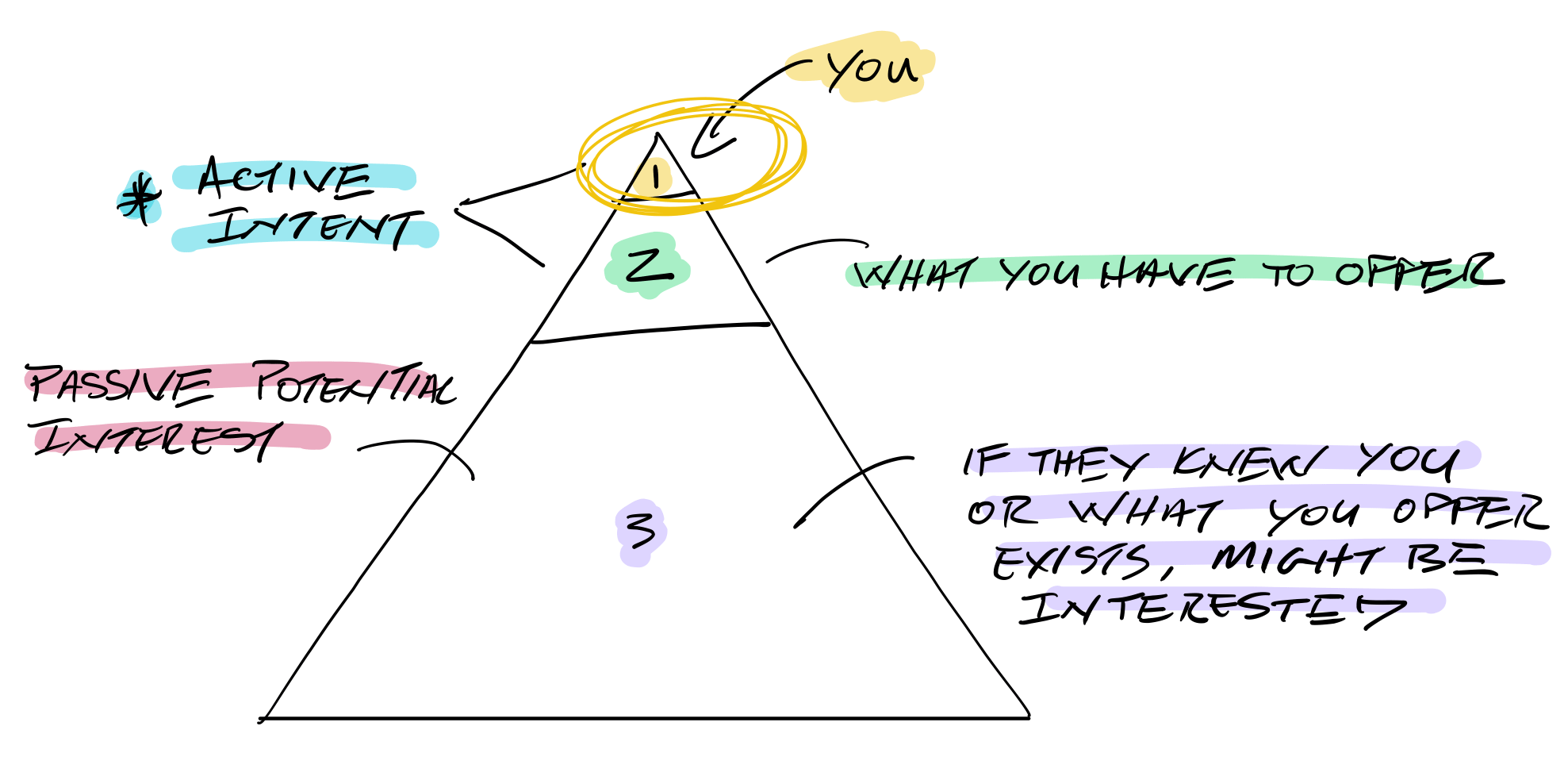
All online traffic — paid or organic — fits into one of three (and only three) categories.
competitive is good. When there's competition that means there's money to be made.
roofing contractor near me is a solution-focused search. how to fix a leaky roof is a problem-focused search.
• Category 1: People Searching for You. (Organic search, paid search — particularly Google and Bing.) Lower volume, ultra high-quality.
• Category 2: People Searching for What You Have to Offer. (Organic search, paid search — particularly Google and Bing. YouTube in certain circumstances.) Higher volume, varying quality depending on search terms, (usually) highly competitive.
• Category 3: People Who, If They Knew You or What You Have to Offer Exits, Might Be Interested. (Facebook, Google Display Network, YouTube, LinkedIn, affiliate emails, etc.) Enormous potential volume, very low overall quality.
‘Back in the day', traffic was cheap and the whole point of paying for traffic (aka buying media) was to get prospects to a landing page. Preferably a bare-bones ‘squeeze page' with a big promise and an opt-in (until Google pulled the plug on that model and entire businesses disappeared overnight).
the days of cheap traffic are long gone, and they're never coming back
make traffic part of the funnel, not an afterthought
think about where you'll get traffic before creating the offer and the funnel, and plan accordingly
Google and Facebook have made the strategic decision that they can thrive financially without relying on businesses that make over the top claims or have sketchy, aggressive business models. That's the new reality and, as a Facebook rep told me quite recently, “yes…we're looking much more closely at certain verticals…”
List #1 is all of the reasons someone might benefit from your offer. Be very specific, and ask (and answer) “why” several times for every item on the list. Write out each answer (yes, you'll have a long list), and then put an asterisk next to the top 5-7 when you're finished.
List #2 is harder — believe me, it's worth it. Make a list of all the reasons why someone might not want to engage with your offer (not your product/service — the offer itself). For example, if you require an opt-in for a 45-minute webinar, your list would include reasons like “prospects don't want to give their email address”, “prospects don't want to sit through a 45-minute webinar”, and “prospects don't want to watch a webinar on their mobile phone”.
List #3 is even harder (remember — we're friends — you can trust me). Make a list of all the ways in which someone could sabotage / undermine the value your product/service provides. For example, if I were making this list for my agency business, I would include the following:
• “Second guessing decisions because of something they read/heard online”;
• “Focusing on methods instead of results”;
• “Micro–managing the process”; and
• “Relying on opinions instead of data for decision–making”.
There's an old saying — complicate for profit, simplify for results. Meaning, if you want to sell something, make it seem super-complicated. Focus on all the moving parts, all the “what ifs?”, future-pace some worst-case scenarios, and convince everyone that only you know how to avoid the deadly quicksand.
In my experience, insiders know that there are a critical few factors that really matter (in any endeavor) — the 5% — and those critical few are responsible for the overwhelming share of results — the 95%.
Near the top of that list is understanding active intent vs. passive potential interest. Do that right and everything is easier.
Another 5/95 idea for paid traffic is to focus on quality first, quantity (a distant) second.
here's one of the most common mistakes I see. I call it the “throw a bunch of ideas as the wall to see what sticks” method
Write one really good ad. Imagine your ideal prospect sitting in front of you:
• What keeps her up at night?
• What problem does she have that you're uniquely qualified to solve?
• What does she want most that you know how to help her achieve?
Write to her — from the heart. Speak to those felt needs, make it clear you understand the problem(s) and desire(s) deeply, and that you have a solution. If that solution isn't right for everyone, be honest about that. If there are hurdles (like opt-ins and webinars), mention that too. Treat your prospects like good friends.
Some of the best performing Facebook ads I've ever seen (from the perspective of generating customers) have been written by business owners with no formal Facebook or copywriting training. How is that possible? Because the copy was authentic, showed deep knowledge of and empathy for the prospect, and demonstrated credibility and authority.
Writing a long-form Facebook ad (650 – 1,000 words) is an opportunity to completely transform how you think about paid traffic. That amount of copy will force you to make a few positive decisions.
First, it will require a deep dive into the value you can offer, who will benefit most from that value, and, perhaps most importantly, who won't. If that sounds familiar it's because those are the questions from lessons three's homework.
Second, a long-form Facebook ad has enough content that it's part of the offer funnel. Thinking about an ad as part of the funnel has many positive downstream effects — particularly cohesion / congruence in your messaging.
Third, long-form ads pre-qualify prospects which dramatically increases the quality of visitors. Higher-quality visitors means better conversion rates, lower refund rates, and longer stick rates — everything we want in happy-customer-generating machine.
Claim + timeframe is a guaranteed ticket to ad disapproval. It's also possible Facebook's AI uses numbers to trigger a human review. An ad rep recently told me “no digits” in ad copy (meaning no numbers — at all — to avoid an algorithmic disapproval).
• Second, avoid using the words you and your in ad copy. Facebook doesn't like specific, direct language that calls out an individual. Again, I suspect you / your is triggered at the AI level so be careful with this in general.
Good ads need to feel like they're social first and that's the tone we'll use.
the first two lines of your Facebook ad will dramatically affect performance
start by asking a question
it's not bragging if you can do it
share what I think are the 3-5 most important things you would want to know
Again, I don't like templates, but this should be the outline to get you started.
Ask a powerful question that is deeply important to your ideal prospect.
Quickly (and with appropriate humility) explain your experience and expertise relative to that question.
Share your top 3-5 insights without getting deep in the weeds. Remember the person you're talking to doesn't know what you know, so use clear, conversational language.
Then, be honest about any factors that would disqualify someone from benefiting from whatever you have to offer.
Finally, tell them what to do next and what will be involved. Don't justify or sugarcoat anything — if someone needs to watch a 90-minute webinar to understand your offer, tell them that.
Every ‘unicorn' ad I've ever seen — the ads with ridiculously great performance — all have used some version of the outline above.
Instead of focusing on business management metrics, people focus on account management metrics like cost per click, click-through rate, cost per thousand impressions (CPM), etc.
One word of warning — this will seem difficult at first. Stick with it. Understanding and internalizing this framework is critical for success with paid traffic.
We only need to know three numbers to manage an online business intelligently:
- CPA,
- AOV,
- and LTV.
The goal is to provide so much value that your AOV and LTV are so high that CPA becomes effectively irrelevant. The moment you can pay more to acquire customers than your competitors everything changes.
If you're using text, I recommend including as much value as possible in the ad itself. Don't force a click-through to more information unless there's a compelling reason to do so. Demonstrate your understanding of a topic, pick a novel perspective, take a stand that's appealing to a motivated minority of your prospects. Be memorable and share-worthy. Likes and other reactions, sharing, and commenting are useful indicators.
If you're already getting a decent amount of traffic to your web presence (website, offer funnel, lead gen front end, online store, etc.), then the place to start is with retargeting.
To qualify for retargeting, someone needs to stay on the page longer than ten seconds, and not opt-in. That'll reduce the size of the audience by half — at least — which also means reducing your cost to retarget by half — at least — while simultaneously increasing the quality of the audience you're retargeting.
Each advertising platform wants to give its users value specific to their needs and desires, that's congruent with users' expectations of the platform.
Google opposes thin-content squeeze pages
Facebook is designed primarily to entertain.
To advertise effectively on Facebook, think in terms of edu-tainment. Create ads that are interesting to your audience, perhaps with a perspective they haven't considered yet. Avoid the quicksand of overly direct language with big promises.
My favorite approach to Facebook ads are those that change perspectives.
The single most important question I ask when reviewing ad copy is “how likely is it that someone will want to share this ad?” (Pro tip: create ads that make your prospects look smart / informed when they share those ads with others.)
Tags: favorite
what are the 2-3 perfect questions you wished prospects would ask you? These questions should be the starting point of an effective paid search campaign.
• Is it interesting to read? Conversational?
• Have you clearly articulated a few insights that aren't common, conventional wisdom for people interested in your expertise?
• Is your ad intriguing — does it capture the reader's interest?
• Is it authentic?
• Is there an “ah ha” moment in it where the reader is shown a different perspective?